
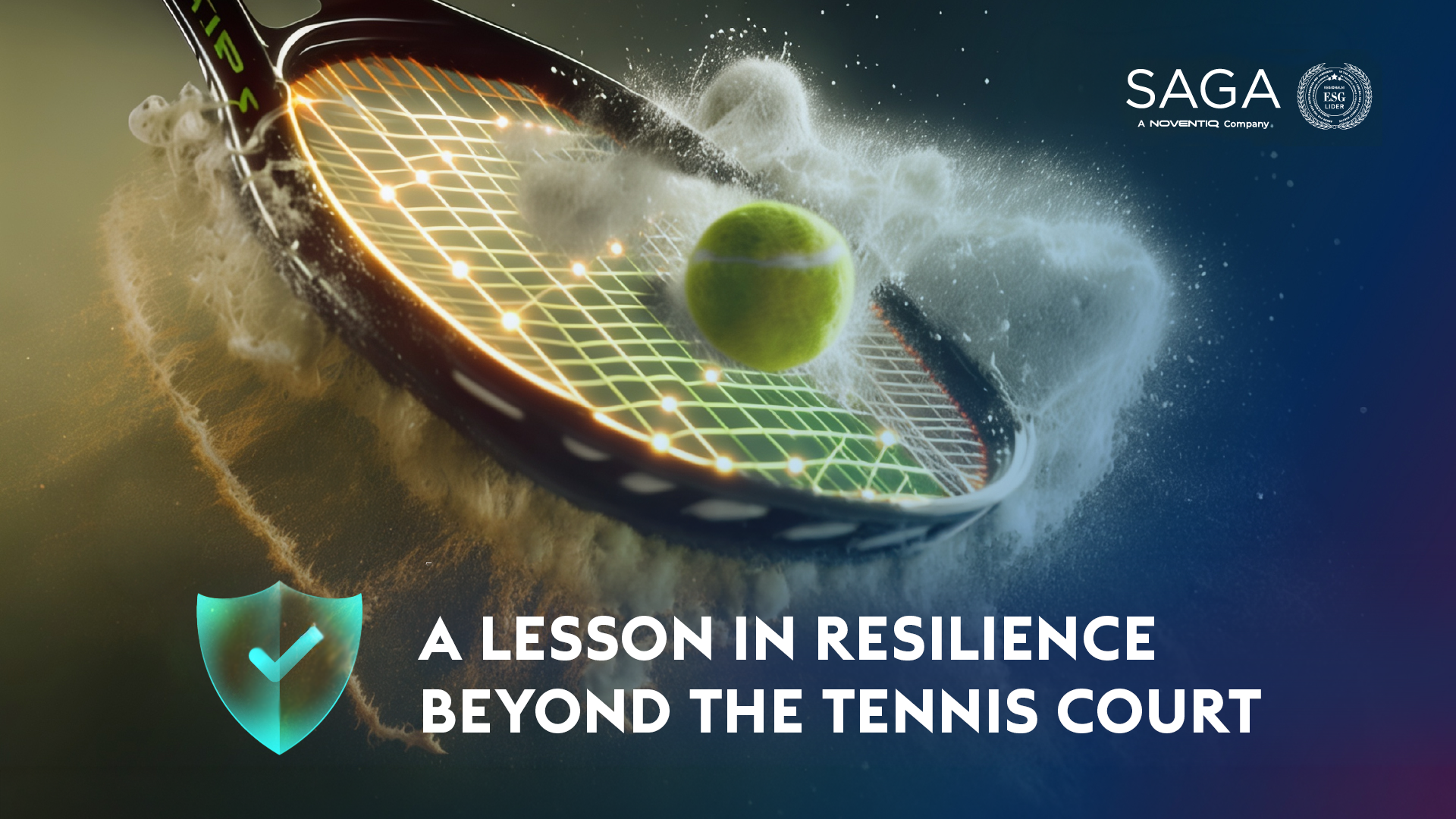
Some matches are not remembered because they were the most beautiful.
They are remembered because they pushed the limits of endurance.
That was exactly the case with Novak Djokovic’s Wimbledon quarterfinal. More than five hours of world-class tennis, constant adjustments, changing momentum, and exceptional physical and mental resilience. A match that proved the winner is not necessarily the one who plays perfectly, but the one who manages to stay composed the longest when the pressure never lets up.
Sounds familiar?
In business, that is exactly what resilience looks like.
Resilience Is Not the Absence of Problems
Today’s companies operate in an environment where change has become the norm.
Cyberattacks are becoming increasingly sophisticated.
IT environments and data management models are growing more complex.
Customer expectations continue to rise.
Regulations keep evolving.
One of ChatGPT’s favorite phrases—“Unexpected disruptions are no longer a question of if, but when”—may have become overused, but that doesn’t make it any less true.
In this environment, resilience does not mean preventing every incident.
It means keeping your business operational despite the incident.
Just as an elite athlete cannot prevent every lost point, but can prevent a single mistake from deciding the entire match.
Business Resilience Begins Long Before a Problem Occurs
Championships are not won in the fifth set.
They are built months and years in advance through training, preparation, strategy, and discipline.
The same applies to business.
Business resilience is not something you switch on when an incident occurs.
It is designed in advance.
Through reliable infrastructure.
Through strong cybersecurity.
Through backup and disaster recovery strategies.
Through monitoring capable of identifying problems before customers notice them.
Through a data storage architecture that is not tied to a single solution, but carefully designed around business needs—whether on-premises, in the cloud, or across a hybrid environment.
In other words, by the time the greatest pressure arrives, it is already too late to start preparing.
The Most Important Question Is Not Whether a Problem Will Happen—Or Even When
The real question is:
How quickly can you respond?
How quickly can you detect an incident?
How quickly can you isolate the risk?
How quickly can you restore your systems to full functionality?
And will your customers even notice that anything happened?
That is the difference between companies that simply react and companies that are truly resilient.
Technology Doesn’t Win on Its Own
Behind every successful infrastructure are people.
System architects.
Engineers.
Experts who determine the best way to store, protect, and manage critical data.
Teams that prepare every day for scenarios everyone hopes will never happen.
Just as five hours of elite tennis are built on thousands of unseen hours of training.
When the Match Lasts Longer Than Expected
The biggest business challenges rarely arrive when we expect them.
But those are exactly the moments that reveal how prepared our systems, processes, and people truly are.
That is why business resilience is not just about technology.
It is an organization’s ability to continue operating even when circumstances become unpredictable.
Because, just like in sport, winners are not those who never face obstacles.
They are those who remain stable long enough to overcome them.
That is why business resilience is not an optional element of an IT strategy.
It is one of the cornerstones of modern business.
When systems, data, processes, and people can respond to unexpected challenges without compromising business continuity, organizations gain what may be their greatest competitive advantage today: the ability to keep moving forward, regardless of the circumstances.
The longest matches—and the greatest business challenges—are rarely won with a single move.
They are won through preparation, discipline, stability, and the ability of a system to endure when pressure lasts longer than anyone planned.
Because in business, just as in sport, victory does not always belong to those with ideal conditions.
It belongs to those who are prepared to remain resilient, even when the match lasts far longer than expected.